Business Ethics Case Studies & Selected Readings
9.6 Example Studies
Culture on the Trading Floor
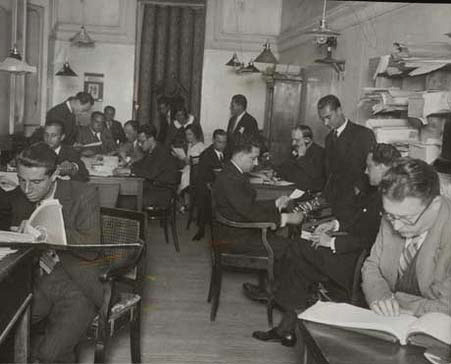
On Wall Street, S&T means sales and trades of stock, and it'southward generally carried out by teams working for a bank or investment firm. Information technology'due south their job to sniff out the all-time buys (and recommend them to their clients), while also picking up on which shares may be in for a fall so they can be unloaded fast.
On one of WallStreetOasis.com'due south forum pages, welcome2nyc starts a thread this mode: I was curious to know the culture of S&T. Can anyone requite an honest opinion?welcome2nyc, March 20, 2010 (9:09 p.1000.), "Culture on the Trading Floor…Changed?," WallStreetOasis.com, accessed May 25, 2011, http://www.wallstreetoasis.com/forums/culture-on-the-trading-floorchanged.
Questions
- What is a corporate culture?
-
A contributor named creditderivatives posts this about the culture at Deutsche Bank Equities: "These guys were brilliant and no-nonsense. Very tolerant atmosphere, only very focused. These guys argued over the correct pricing approach for disinterestedness swaps as opposed to which March Madness bound squad had the best gamble of winning information technology all."
An "equity swap" is a circuitous fiscal bet, but in the end information technology comes down to this: one side believes a stock will go upwardly (or down) more than than another, and they put money on it.
- There'southward non a lot of information here, but from what you accept, tin you brainstorm a short listing of words fitting the civilisation and values Deutsche Banking concern fosters?
- One important characteristic of corporate culture is employee interaction: the way workers relate to each other on the job. At Deutsche Bank, does it sound like the culture values teamwork amongst workers, contest, or some mix? Explain.
-
BigFatPanda writes, "I'd rather work on a desk-bound with the trash talk, like where people are on the verge of cutting each other."
"A desk" is Wall Street talk for a squad of analysts working together on investment strategies.
- How would you describe the culture BigFatPanda prefers?
- One of the recurring questions all managers face up is "Will more than and better work get done if people work together or compete with each other?" It's pretty obvious where BigFatPanda comes down on this. From what he says and the fashion he says it, what do you suppose are some of the potential disadvantages of this organizational civilisation of contest?
-
jjc1122 writes, "When i used to work at the chicago mercantile exchange, at that place were a lot of crazy stuff. traders routinely doing coke in the bathroom, erstwhile irish gaelic guys hurling racial insults, fights, and sleeping with their hot female clerks."
He adds that his experience dates from 2005, simply he'd heard that things were actually a lot crazier in the earlier part of the decade.
- Two aspects of corporate culture are workplace mood (the social free energy and decorum of an function) and leisure time (what coworkers do and the manner they relate to each other when not at work). How has jjc1122's managing director tuned those aspects of the system's culture?
- One aspect of working culture involves life values—that is, the extent to which on-the-job experience leaks out to colour nonwork concerns and life. What kinds of life values are exhibited past this organization? What kind of theoretical ethical argument could exist made to criticize the manager's promotion of these values?
- The ii basic ways that an organizational culture is instilled are codes (established rules guiding an organization's members) and social conditioning (guidance is provided by post-obit the cues and examples of others in the arrangement). Do you lot suspect the values of jjc1122's Chicago Mercantile Exchange workplace were established more past codes or social workout? Why?
-
The instillation of a workplace culture through social conditioning functions in a variety of ways. Three are listed hither. Can you make full in for each how information technology may have worked in the Chicago Mercantile Exchange in 2005?
- Stories and myths embedded in daily conversations may indicate culturally advisable behave.
- Heroes or stars in the organization may consistently communicate a mutual message about the organisation's guiding values.
- The dress, spoken communication, and physical work setting may exist arranged to cohere with the organization's values.
- One social style that an organizational civilisation may reinforce itself is through a self-selective procedure. What is a self-selective process? How might that process take worked to reinforce the values guiding work life at the Chicago Mercantile Exchange?
-
Bondarb writes, "When i am out with goldman people and somebody tells a joke they all expect at the most senior GS person there to run across if they are immune to laugh." GS is Goldman Sachs, the global investment bank.
- Make the case that employees constantly looking to superiors for guidance—even whether they should express joy at a joke—shows that a strong, articulate corporate culture exists at Goldman.
- Brand the example that employees constantly looking to superiors for guidance—even whether they should laugh at a joke—shows that a weak, ill-divers corporate culture exists at Goldman.
Corporate Civilisation at Herschend Family unit Entertainment

Joel Manby is CEO of Herschend Family unit Entertainment, a $300 1000000 corporation employing more than than 10,000 people at two dozen theme parks around the state. They put on everything from massive aquariums to Dollywood, the Dolly Parton theme park in Tennessee.
In an interview, Manby discusses the corporate culture infusing the properties. It's equanimous of eight attributes:
- Patience
- Kindness
- Honesty
- Humility
- Respectfulness
- Selflessness
- Forgiveness
- Commitment
Manby exemplifies the corporate values he'due south trying to instill this style, "You lot tin can dislike somebody, simply you lot can still respect them, forgive them, and care for them with humility and honesty. Nosotros likewise accept a phrase: 'admonish in private, praise in public.' Then you lot don't embarrass people."
Manby explains that 50 percent of a Herschend executive'due south year-cease bonus is awarded on the basis of how well the organisation'southward culture is exhibited and promoted. As he puts information technology, "You have to put your money where your mouth is."
He concludes with this: "It's all most hiring the correct people. You know, this culture either resonates with people or it doesn't. If it doesn't, they're not going to enjoy working here."Steve Tobak, Undercover Dominate: Escaping GM'due south Abusive Corporate Culture," The Corner Role (blog), BNET, March 30, 2010, accessed May 25, 2011, http://blogs.bnet.com/ceo/?p=4254.
Questions
-
The characteristics of corporate culture elaborated in this affiliate were the following. Corporate culture is
- shared,
- a provider of guidance,
- a provider of pregnant in the organisation,
- top heavy,
- a constellation of values,
- a dynamic constellation of values,
- organic,
- inclusive of life values.
Choose three of these characteristics and show how the culture Manby promotes at Herschend Family unit Entertainment relates with each one.
- What is a corporate civilization ideals audit? What does information technology attempt to measure?
- If a corporate culture ethics inspect were taken of this visitor, how do you suppose information technology would fare? Why?
-
Before coming to Herschend, Manby was CEO of Saab, a partition of General Motors. His time in that location was marked by a very different organizational civilization. According to him, "I don't want to bash GM, just intimidation was function of the civilization there. You would get ridiculed in meetings. The CEOs had big egos and had no problem making you look lightheaded. I once missed 1 of my numbers. I didn't miss information technology by that much, but the president of all of Saab calls me and orders me to fly over there [to Europe]. I get at that place Monday morning time, he chews me out for four hours, and so I get on a plane and fly back. It was so humiliating, then uncalled for. I figured, if that's the way I'1000 going to be treated, I don't need that. That's when I began looking at other opportunities."Steve Tobak, Undercover Dominate: Escaping GM'southward Abusive Corporate Culture," The Corner Part (blog), BNET, March 30, 2010, accessed May 25, 2011, http://blogs.bnet.com/ceo/?p=4254, brackets in the original.
Manby lists the attributes of the civilisation at Herschend—patience, kindness, honesty, and and so on. What might a similar list look similar for Saab?
-
Corporate culture provides an organisation's meaning; it defines what counts as success.
- For Herschend, what counts as success?
- For Saab, what counts equally success?
-
A corporate civilisation distinguishes workers from people who work. What is the distinction?
- How does Herschend fit into this distinction?
- How does Saab fit into this distinction?
-
Manby says, "Apple's culture, for case, would be very unlike from ours, merely Steve Jobs is still an incredibly successful CEO. I'm not pretending we're right and others are wrong; it's just our culture, and it works for usa."
Explain how Manby tin say that a prepare of upstanding values isn't correct or wrong, but 1 gear up (at Saab) is wrong for him, and another set up (at Herschend) is right for him?
Even Better Than the Real Thing

The web shop FinerBags.com sells fakes—very good copies of purses originally made by Louis Vuitton and similar loftier-cease brands. The toll is right: a $1,800 Prada bag can be purchased as a re-create for nearly $180. At Finer Numberless, they're totally open nigh what they're doing, and their home page lists the advantages of ownership their products. According to the leadership at Effectively Bags, "Millions of replica handbags can exist found on net these days, they are not a rare thing anymore. Maybe the Louis Vuitton handbag that your friend bought is a perfect replica. Perhaps the Louis Vuitton Monogram Speedy 30 that Linda paid $1,200 for is a replica purse. Perchance those replica bags all were bought from finerbags.com."Business concern Ethics Workshop, accessed May 25, 2011, http://businessethicsworkshop.com/Chapter_9/finer_bags.html.
Questions
- Would yous telephone call honesty function of the corporate culture at Finer Numberless? Yes, no, or both? Explain.
- Corporate cultural dissonance occurs when what actually happens on the ground doesn't jibe with the principles supposedly controlling things from above. Do you suspect that racket is occurring here? Why or why not?
-
This company is selling counterfeit purses, bags designed to flim-flam people into thinking they're real when they're not. No i denies that.
- Could you employ a utilitarian argument (bring the greatest good and happiness to the greatest number) to justify this corporate culture and business endeavor equally ethically respectable?
- Could y'all utilise either a basic duties argument (right and wrong is defined by preexisting principles) or Kant'due south chiselled imperative (to exist correct an act must be universalizable) to brand the upstanding case that this company should put itself out of concern?
-
This line from the web page is curious: "Maybe the Louis Vuitton Monogram Speedy 30 that Linda paid $1,200 for is a replica handbag." It's important to know that the price of the real affair is most $1,200. The bespeak being made is that people tin end up paying total price for a copy. If that's truthful, information technology sounds similar Effectively Bags is inviting people like y'all and me to realize that nosotros can buy their fakes and and so sell them as existent, pocketing the difference.
- Imagine you buy a few replicas for $120. Then you spread word around campus that your mom is a major section store buyer and handed off a few Louis Vuitton Monogram Speedy 30s that you're now selling at the absurdly low price of…$800. Can you sketch an argument to ethically justify your business organisation model? What kind of ethical theory could it be based on? How would you lot reply to a consumer who discovered the pull a fast one on?
- Imagine you have and then much success that you hire some friends to go around selling bags at nearby colleges. Would you tell them the truth near the source of your bags or keep up the mommy prevarication? Why? What ethical justification could you sketch to support your decision?
- One reason to lie to the people you lot hire to sell the bags elsewhere is to assistance them practise their task well. If they believe the bags are the real thing, they may notice it much easier to enthusiastically promote their product. Is in that location any ethical difference between lying to employees to assist them amend their work performance as purse salespeople and lying to consumers about what they're getting when they make a purchase? If non, why not? If so, what's the departure?
- Tin can you think of examples in the world where managers don't tell their employees the whole truth about a situation and believe they're doing the right thing? What is such a state of affairs? Is it the right thing?
- Assume you lot're running the fake handbag outfit and hiring sales reps for other schools. You decide to maintain the lie nearly the purses' origin. How do you lot think your small concern would fare on a corporate civilisation ethics audit? Why?
-
Assume you're running the fake purse outfit and hiring sales reps for other schools. You determine to reveal the truth about the purses' origin to the reps. What you need to do next is instill a corporate culture that fosters lying. Common ways of instilling a workplace culture include the following:
- The founder's upstanding legacy to the organization may contribute to its living culture.
- Stories and myths embedded in daily conversations may indicate culturally appropriate conduct.
- Heroes or stars in the organization may consistently communicate a mutual message about the organization'south guiding values.
- The wearing apparel, speech, and physical work setting may be arranged to cohere with the organization's values.
- An organizational civilisation may reinforce itself through self-selective processes.
How might these or other strategies of social conditioning be used to create a working culture that values lying?
- If you talk over this case in grade, there'll be people loudly proclaiming that this simulated pocketbook business is despicable and completely wrong. And then they'll go dwelling house, hitting up finerbags.com on the Internet, and spend the next 60 minutes trying to effigy out if they can make the scheme work on your campus. It is good coin. At present, is in that location any ethical difference between someone who lies in a social state of affairs similar a form and someone who lies as a way of doing business?
"I Created Studio 54!"
Not all leadership jobs are exercised from on top of a pyramid, with the president on the highest level, vice presidents below, then directors beneath them, and so on. Take the example of Carmen D'Alessio. "I created Studio 54!" she proclaims, even though she didn't own any office of the club or have whatever official part in the way information technology was run. Nevertheless, according to her, if you want to find out about the once-thriving business, "I'chiliad the most of import person to talk to."Jada Yuan, "Equally the Disco Ball Turns," New York, April 30, 2007, accessed May 25, 2011, http://nymag.com/news/features/31277.
In the 1980s, Studio 54 was the New York Metropolis club. It began, according to D'Alessio, soon after she dined with 2 men—Ian Schrager and Steve Rubell—who endemic a social club in Queens, New York, an surface area not considered particularly trendy. She idea that Rubell possibly had some raw night-clubbing talent, and then she encouraged him to bring his skills to hipper Manhattan.
To generate buzz before Studio 54 actually opened, she dressed Schrager and Rubell in Armani suits and threw a dinner in their honor attended by celebrated creative person Andy Warhol, clothing designers Halston and Calvin Klein, and a host of similarly bright luminaries. Then, on the guild'southward first night, they went for an outlandish theme fustigate: 1001 Nights with elephants, camels, tents, men wearing turbans, belly dancers, and everything else packed onto the disco floor. Soon later the remarkable event, a widely distributed magazine at the time, Newsweek, put Studio 54 on their cover.
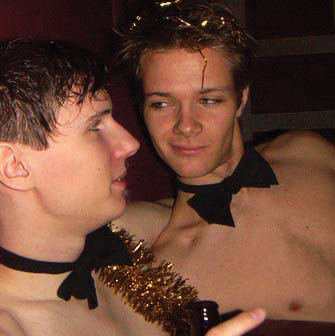
The parties D'Alessio threw were as outrageous and scandalous equally the guests who turned up. 1 dark Bianca Jagger (ex of Mick) rode in on a white horse; on another the designer Valentino got to human activity equally the ringleader of real circus animals. Armani was feted with a elevate-queen ballet. The bartenders were young, male, built, and shirtless. The busboys doubled equally entertainers: dressed in tight piddling white shorts, bowties, and nothing else, they were given illicit drugs and a small-scale paycheck and told to pick up spectacles and party with the guests, who included fashion designers, artists, and unique people like Johannes von Thurn und Taxis, a flaming and wealthy European aristocrat whose wife was thirty years younger and so explosive that people called her Princess TNT. Malcolm Forbes, the difficult-nosed American businessman, was a regular too. Everyone was welcome, as long as they were interesting.
In talking about it now, Carmen D'Alessio gives credit to the others, but never lets anyone forget what Andy Warhol said about Studio 54's more visible leaders, Ian Schrager and Steve Rubell: "Carmen brought, paw in hand, Ian and Steve to the Large Apple tree."
Questions
-
The line outside Studio 54 was infamous. People stretched around the block and waited hours to go in. Some waited all nighttime and never reached the door. One reason things went and then slowly for many is that D'Alessio enjoyed swooping out of the order, running down the line, and hand picking people to leap ahead and go straight in.
- Andy Warhol said this about D'Alessio: "She has gone everywhere from Rome to Rio. Anywhere there is a political party and until the party lasts, she'll exist there, because she has a list of the rich, the cute and the young."Steve Lewis, "Practiced Night Mr. Lewis: Carmen D'Alessio's Fabulous Life," blackbookmag.com, December 11, 2008, accessed May 25, 2011, http://www.blackbookmag.com/article/good-dark-mr-lewis-carmen-dalessios-fabled-life-part-two/5463. Can you make a expert guess about the kind of people that D'Alessio chose for quick entry?
- Essentially, D'Alessio chose some clients for better service than others. Justify this management strategy ethically.
- Another amusement company with lines is Herschend, the parent corporation of many Disneyland-similar theme parks around the state. The lines there—waiting to get on the roller coaster, to purchase popcorn, to go to the bathroom—are commencement come, first served. The values Herschend uses to ascertain its culture (patience, kindness, honesty, humility, respectfulness, selflessness, forgiveness, commitment) fit well with the egalitarian treatment. If you were in charge at Studio 54, what kind of values could you assortment to help employees and others understand why the line outside the bar moved so unevenly?
-
Studio 54 was a big-time vice den. Upstairs in the shadowy balcony people regularly coupled. Drugs were every bit common as beer. (A big glittery moon with a face and artillery hung from the ceiling. Information technology was snorting cocaine.) Management knew most all this and encouraged it.
- With a focus on the facts that D'Alessio and company generally hired young, attractive, and muscular men, asked them to piece of work with nigh no clothes, and fed them drugs to burnish their attitudes, how would you characterize management's civilization with respect to employees? Were they valued as mercenaries, every bit something closer to members of a family, equally something else? (Remember, guys lined upwards to apply for these coveted posts.)
- How would you depict the Studio 54 mental attitude toward its consumers? Were they valued as people to be fleeced of their coin, equally participants in a shared projection? Something else? Why do you retrieve that?
-
Though non a lot of clothing was worn by frontline employees, this doesn't modify the fact that there was a very strict dress code at Studio 54.
- In ethical terms, is there whatsoever departure betwixt requiring guys to clothing almost nothing while they hustle around the bar delivering drinks and, in a different business concern, requiring guys to wear neat, stiff uniforms while they hustle around a neighborhood delivering Domino'due south pizzas? If there is a divergence, what is it? If not, why non?
- Different Domino's, Studio 54 had a semiofficial body requirement for employees: the guys needed to be bulky and fit. In thinking most the management conclusion to impose both dress codes and torso requirements, how are these 2 demands similar and how are they different? Is i less ethically problematic than another? Why or why not?
- What are some ethical justifications an owner could cite for enforcing a dress code in general, regardless of whether it's a near-nude barboy or a Domino'south commuter? How would those arguments apply in the specific case of Studio 54?
-
Carmen D'Alessio was behind the scenes at Studio 54, throwing the parties, arranging people, setting the tone of the place. With respect to Daniel Goleman's six bones leadership personas listed below, which ones exercise you suspect stand for with D'Alessio, and which don't fit her so well? Why?
- Visionary
- Coach
- Affiliative
- Democratic
- Pacesetter
- Commander
- What is transformational leadership? What is transactional leadership? Does D'Alessio share characteristics with one or both? How?
-
Part of the reason for naming a leadership style a leadership persona is to underline the idea that being a leader tin exist like donning a mask: yous tin be whatever you choose when you stand in front of others and directly. Besides being a leader at Studio 54, D'Alessio was besides a massive partier. How is adopting a personality for leading an arrangement like adopting a manner to exhibit when you exit with friends on the weekend?
- Is there annihilation ethically wrong with adopting a mask for your public self? Is then, what? If not, why not?
stricklandhatomentand.blogspot.com
Source: https://saylordotorg.github.io/text_the-business-ethics-workshop/s13-06-case-studies.html
0 Response to "Business Ethics Case Studies & Selected Readings"
Post a Comment