Mommy and Baby Elephant Connection With Tail With Gold Foil on White Canvas
Elephants: Earth'south Largest Living Land-Animals
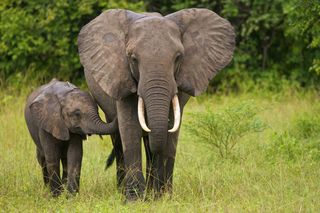
Elephants are the largest land animals on Earth, and they're one of the virtually unique-looking animals, too. With their characteristic long noses, or trunks; large, floppy ears; and wide, thick legs, at that place is no other fauna with a similar physique.
Nigh experts recognize ii species of elephant: the Asian elephant (Elephas maximus) and the African elephant (Loxodonta africana), who live on separate continents and have many unique features. There are several subspecies that belong to one or the other of these two main species, though experts debate over how many subspecies there are and whether or non they constitute separate species, according to the San Diego Zoo.
African and Asian elephants
African elephants alive in sub-Saharan Africa, the rainforests of Key and Due west Africa and the Sahel desert in Mali, according to National Geographic. Asian elephants live in Nepal, Republic of india and Southeast Asia in scrub forests and rainforests. [Elephant Images: The Biggest Beasts on Country]
African elephants are the larger of the two species. They abound to between eight.two and thirteen feet (2.5 and 4 meters) tall at the shoulder and weigh 5,000 to xiv,000 lbs. (2,268 to 6,350 kilograms), according to National Geographic. Asian elephants are just a fiddling smaller, growing to between 6.6 and 9.8 feet (2 and three thousand) tall at the shoulder and weighing betwixt 4,500 and 11,000 lbs. (2,041 and 4,990 kg). In the wild, African elephants can alive up to 70 years, and Asian elephants up to threescore years.
African and Asian elephants also take a few different physical features.
The ears of African elephant are larger and resemble the shape of the African continent, while Asian elephants have smaller, rounder ears, according to the San Diego Zoo.
Both male and female African elephants take large tusks and 2 "fingers" on the terminate of their trunks to help them pick items up. Asian elephants have a unmarried "finger" on the end of their trucks. But typically, but male Asian elephants volition abound large tusks, while the females and a few males have much smaller tusks called tushes that don't always abound outside the mouth.
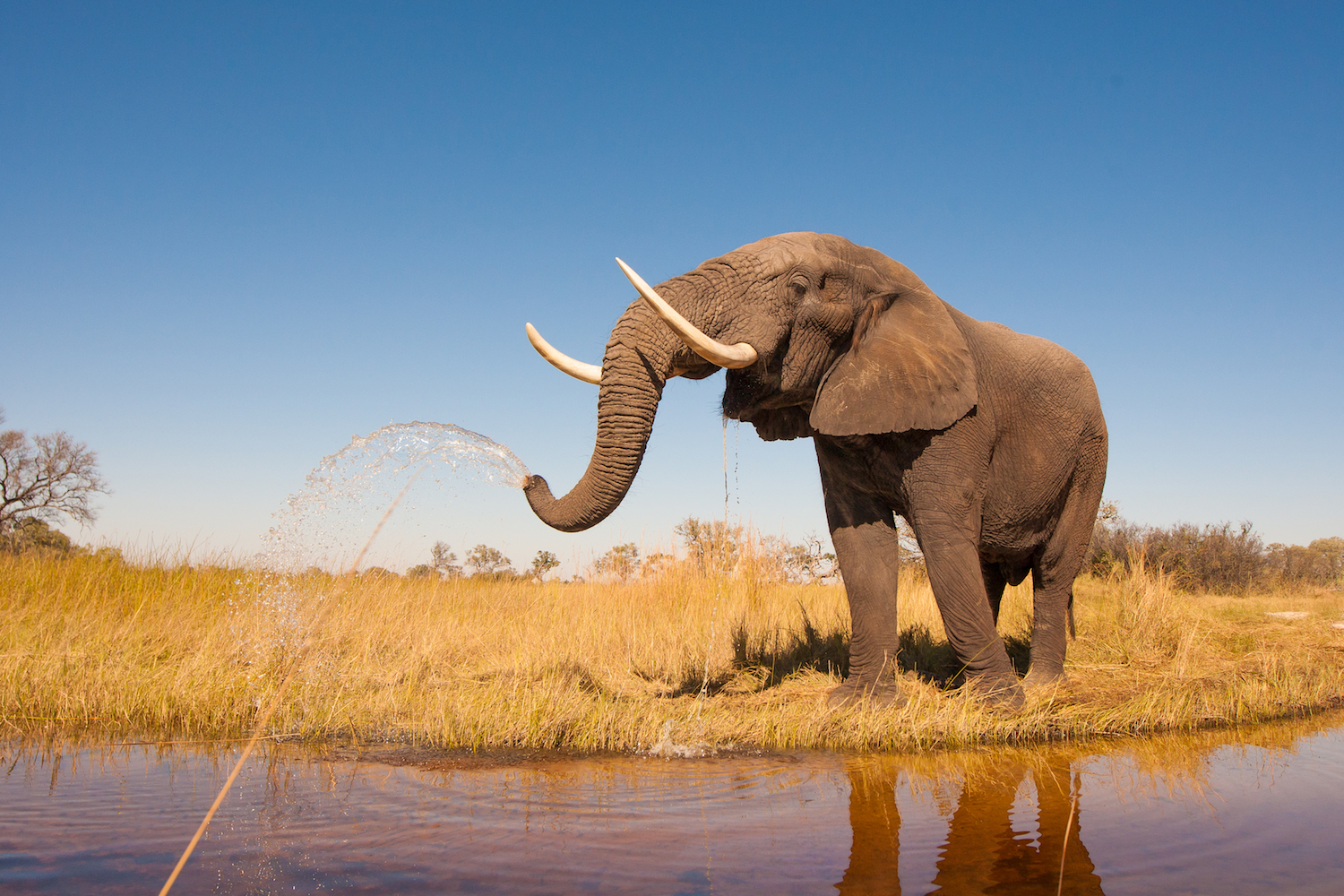
Tusks are large, deeply rooted teeth that evolved to assist the elephant in digging, lifting, gathering food, and defense while too protecting the trunk, according to World Wild fauna Fund. In the same way that humans tend to exist right-handed or left-handed, elephants can be right-tusked or left-tusked. Their ascendant tusk is piece of cake to place, considering it will be more worn downwards than the less dominant tusk, according to the Globe Wildlife Fund.
Both species eat all types of vegetation, including a variety of grasses, fruits, leaves, bark and roots. They spend about virtually sixteen hours eating, consuming anywhere from 165 to 330 lbs. (75 to 150 kg) of food per day, according to the San Diego Zoo.
Elephant life
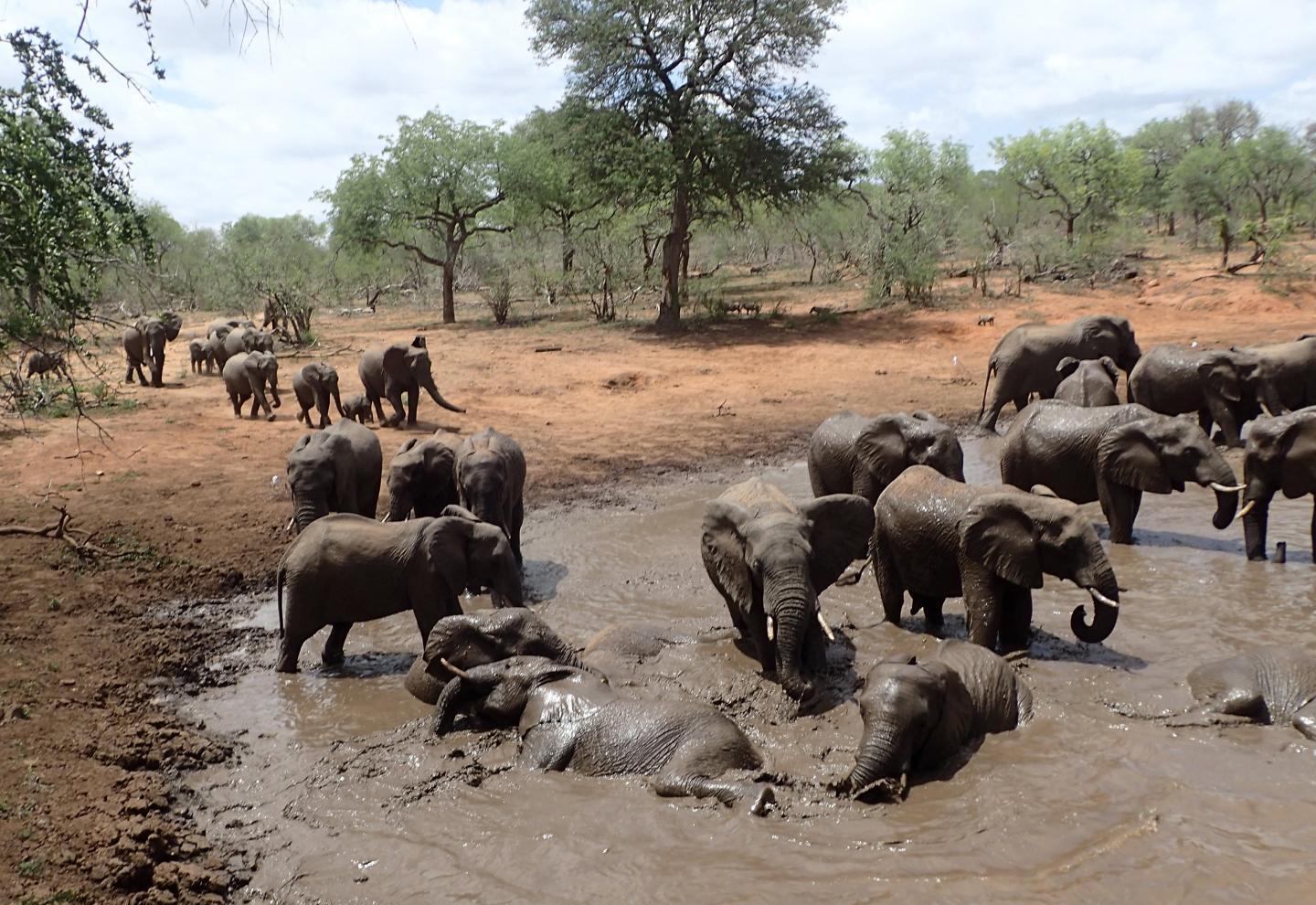
Groups of elephants, or herds, follow a matriarchal structure with the eldest female in charge. Herds are composed of primarily female person family members and immature calves, according to the San Diego Zoo, and include half-dozen to 20 members depending on the food supply. When the family gets also big, herds often dissever into smaller groups that stay within the same expanse.
The matriarch relies on her experience and memory to retrieve where the all-time spots for nutrient, h2o are, and where to find protection from the elements. The matriarch is as well responsible for instruction the younger members of her family how to socialize with other elephants.
Elephants are very social and can communicate with ane another and identify other elephants from distances of up to 2 miles using rumbling, low-pitched sounds that fall below the audible range of humans, co-ordinate to the National Zoo.
Elephants readily show good manners to members within its herd and other herds, co-ordinate to the San Diego Zoo. For instance, they apply their trunks to greet ane another, either past belongings it out high or by inserting the terminate of their trunk into another elephant's mouth.
Elephants besides pay close attention to the well-existence of all the members of their herd, and will do what they can to take care of and protect weak or injured members.
They're considered an extremely intelligent species, and have been observed showing avant-garde problem-solving skills and demonstrating empathy, mourning and self-awareness, according to an commodity in Scientific American.
Next generation
Male and female elephants become sexually mature between viii and 13 years of age. Male elephants will get out their herd around this fourth dimension, as long as they're able to observe their ain nutrient and protect themselves, co-ordinate to the Smithsonian National Zoo. Adult males either alive on their ain or in small bachelor herds.
Females may not have their first dogie until their centre teen years, while males may not begetter a calf until they are in their 30s, when they are big and strong enough to compete with other males, co-ordinate to the National Zoo.
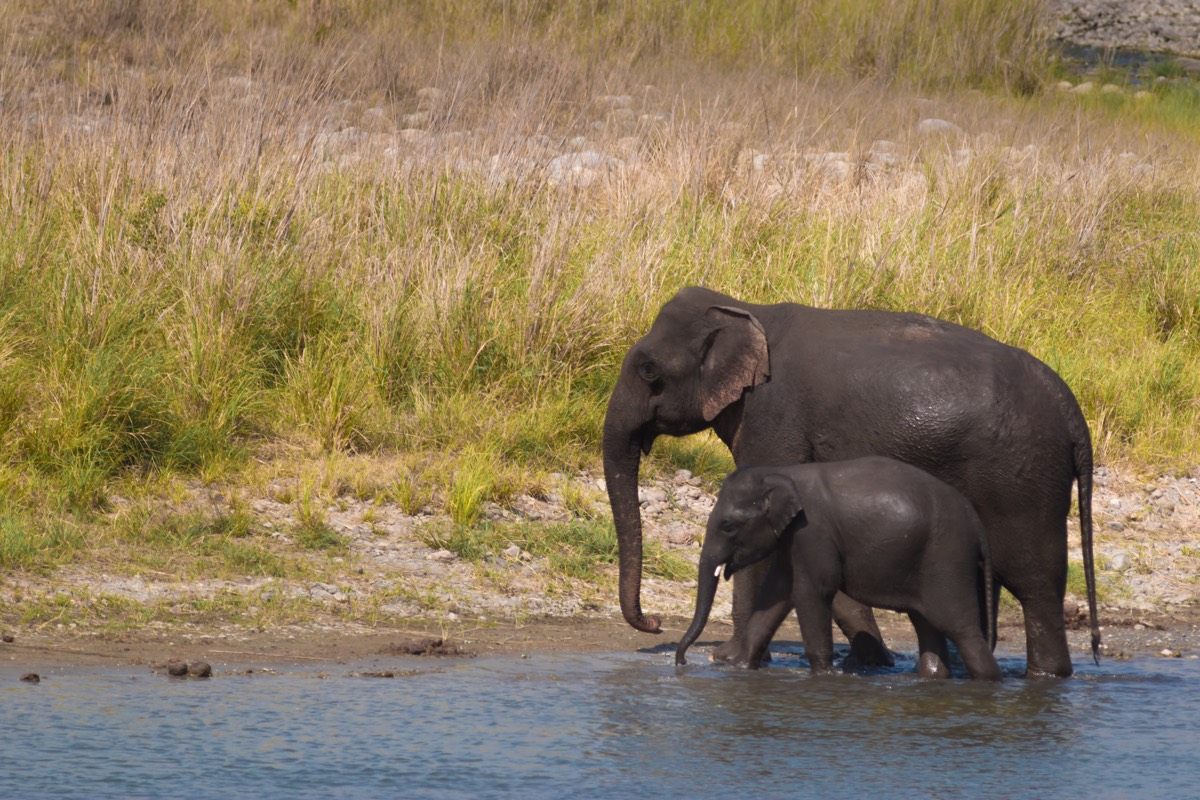
Usually, only a single calf is born following a 22-calendar month pregnancy. A newborn calf weighs between 150 and 350 lbs. (68 and 158 kg) stands about 3 feet alpine. Calves besides tend to be hairy with long tails and very brusk trunks.
Elephant calves grow apace, gaining 2 to 3 lbs. every solar day in their first year, according to the San Diego Zoo. By the time they are 2 or 3 years former, calves are ready to be weaned.
Classification/Taxonomy
All elephants are mammals belonging to the elephantidae family. At that place are two subspecies of the African elephant: the savanna (or bush-league) elephant (Loxodonta africana) and the forest elephant (Loxodonta cyclotis). However, forest elephants may in fact be a distinct species of elephant instead of a subspecies, according to Cornell University.
There are three subspecies of Asian elephant: the Indian elephant (Elephas maximus indicus), the Sri Lankan elephant (Elephas maximus maximus), and the Sumatran elephant (Elephas maximus sumatranus). Some other possible subspecies is Elephas maximus borneensis (Borneo pygmy elephant). The Globe Wildlife Fund has determined that DNA evidence suggests that the Borneo pygmy elephant is genetically different from other Asian elephants.
Conservation status
The International Union for Conservation of Nature and Natural Resource (IUCN) classifies the Asian elephant as endangered. Though it is not known exactly how many Asian elephants remain, experts believe that the population is decreasing.
The African elephant is considered vulnerable, according to the IUCN, and the species' population is increasing. According to the African Wildlife Foundation, there are effectually 415,000 African elephants in the wild.
Threats against the survival of both African and Asian elephants include poaching and habitat loss, according to World Wild animals Fund.
Additional resources:
- Check out more interesting facts nigh African elephants on the Elephants for Africa website.
- Learn more than most elephant conservation from the International Elephant Foundation.
- Meet the adorable babe elephants beingness cared for at Elephants Without Borders elephant orphanage in Republic of botswana.
This article was updated on March 18, 2019, by Alive Science Contributor Rachel Ross.

Alina Bradford is a contributing author for Live Science. Over the past sixteen years, Alina has covered everything from Ebola to androids while writing wellness, science and tech articles for major publications. She has multiple health, condom and lifesaving certifications from Oklahoma State Academy. Alina's goal in life is to try as many experiences as possible. To date, she has been a volunteer firefighter, a dispatcher, substitute teacher, artist, janitor, children'due south volume author, pizza maker, outcome coordinator and much more.
stricklandhatomentand.blogspot.com
Source: https://www.livescience.com/27320-elephants.html
0 Response to "Mommy and Baby Elephant Connection With Tail With Gold Foil on White Canvas"
Post a Comment